
Key Takeaways
- Most NYC property owners are responsible for sidewalk maintenance adjoining their properties and can be held liable for neglect.
- Exceptions exist for small owner-occupied residential buildings and city-owned properties.
- Timely evidence gathering and legal reporting are crucial to protect your claim.
Slip and fall accidents on sidewalks are a common hazard in New York City, especially during the winter months when ice and snow can accumulate rapidly. Understanding liability for these incidents is crucial for anyone who has been injured and is seeking compensation. Whether an injury results from a cracked pavement, unshoveled snow, or another hazardous condition, knowing your rights is the first step to recovery. For guidance on navigating liability issues, visit 24injurylaw.com, where experienced legal professionals can help you evaluate your next steps after a sidewalk slip and fall.
In New York City, liability for sidewalk accidents is guided by specific local regulations. Both property owners and the city itself can be held responsible, depending on the circumstances. It’s essential for those affected to not only understand these distinctions but also to act quickly and document everything related to the incident to improve their chances of a successful claim.
Property owners have a legal duty to maintain the safety of the sidewalks adjacent to their premises. Still, there are exceptions and special rules that apply to certain types of properties. These legal nuances can make or break a claim, especially when city property or one- to three-family homes are involved.
When dealing with these complex and often stressful incidents, the process for proving negligence, filing claims, and seeking fair compensation can feel overwhelming. That’s why knowing your rights, responsibilities, and options immediately following an accident is essential for achieving the best possible outcome.
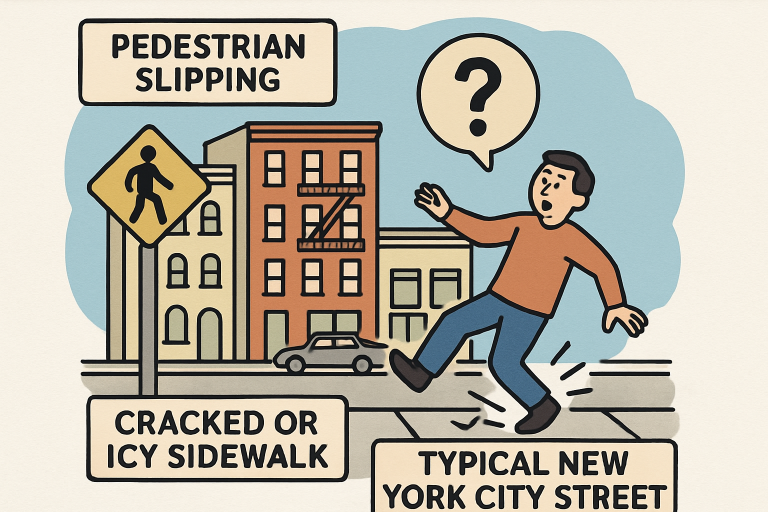
Property Owner Responsibilities
Under New York City Administrative Code § 7-210, property owners (including businesses and certain residential landlords) have a legal obligation to maintain the sidewalks next to their properties. This maintenance includes fixing cracks and unevenness, promptly clearing snow and ice, and generally ensuring the sidewalk is free from hazards that could result in injury. If an owner fails in this duty and someone slips, trips, or falls, the owner may be held liable for any resulting injuries.
The law also requires owners to act “reasonably.” That means shoveling snow within a few hours after a storm passes and routinely inspecting sidewalks for damage. If an injury occurs because of a hazard the owner knew or should have known about but didn’t fix in a reasonable amount of time, the law supports the injured party’s right to pursue compensation.
Exceptions to the Rule
There are critical exceptions to the default rule of property owner liability. Owners of one-, two-, or three-family residential properties who both live in and exclusively use the property as their home are generally exempt from the sidewalk maintenance liability requirements. In these situations, provided the sidewalk is not used for commercial purposes or left in a deliberately hazardous state, the responsibility to maintain and repair sidewalks typically shifts back to the city.
This exception is significant because many homeowners may unknowingly be covered by the city’s insurance and legal protection in cases where an accident occurs, rather than being personally liable for damages.
City Liability
The City of New York is directly responsible for sidewalks bordering city-owned buildings, public parks, and certain exempt residential properties. Moreover, if a sidewalk defect is the direct result of city construction, lack of maintenance, or the city’s failure to act on known hazards, victims may pursue a claim against the municipality. Importantly, strict notice requirements exist when filing against the city, making it crucial to act quickly and follow legal procedures exactly.
Claims against municipalities are strictly regulated for a reason. Municipal governments must be given prompt notice of potential lawsuits to facilitate investigation and potential settlement.
Proving Negligence
Winning a slip and fall claim requires the victim to prove that the responsible party (whether a property owner or the city) was negligent. Negligence, in this context, means that the responsible party either knew or should have known about the dangerous condition and did not remedy it in a reasonable timeframe. Evidence such as photographs taken immediately after the accident, maintenance logs, prior complaints, and eyewitness testimony can prove invaluable. Medical records and reports tying the injury to the accident are also central parts of a successful claim.
What Evidence Is Most Effective?
- Time-stamped photos of the scene and hazard
- Written statements or contact info from witnesses
- Official reports or complaints made to the owner or city
- Records showing a pattern of neglect or non-repair
Steps to Take After an Accident
- Seek Medical Attention: Prioritize your safety and health by seeing a doctor after any slip and fall, even if you initially feel fine. Injuries can become apparent hours or days later.
- Document the Scene: Photograph the area, focusing on the hazard that caused your fall—measure or note any cracks, icy patches, or other dangers.
- Gather Witness Information: Secure contact details for anyone who saw the accident, as their accounts can support your version of events.
- Report the Incident: Alert the property owner or local authorities (such as 311) as soon as possible. This creates an official record proving the incident location and hazardous conditions.
- Consult a Legal Professional: Experienced personal injury attorneys can guide you through documentation, liability determinations, and negotiating with insurance companies or city officials.
Legal Timeframes and Notices
Pursuing a slip and fall claim against New York City triggers special legal timelines. Most notably, you must submit a formal Notice of Claim within 90 days of the accident. This document alerts the city to your intention to pursue damages and enables them to conduct an investigation. Missing this deadline almost always results in your claim being denied. For property owner cases, the statute of limitations generally gives you three years to file a lawsuit, but acting quickly ensures evidence is preserved and witnesses are reachable.
Seeking Legal Assistance
Premises liability laws in New York City blend local statutes, property regulations, and a complex claims process. For those harmed on city sidewalks, an attorney specializing in sidewalk accidents can help prove negligence by the owner or city, accurately assess damages, and ensure all paperwork is filed on time. Compensation may cover medical bills, lost earnings, pain and suffering, and future care, depending on the extent of your injuries.
Understanding your rights can dramatically shape your recovery after a sidewalk slip and fall in New York City. By acting promptly after an accident and securing the services of a qualified lawyer, victims can maximize their chances of receiving fair compensation and justice.